Services

Soil and Groundwater
Remediation Cambridge

Carried out using the most practical, sustainable and appropriate technique(s), only applied once we have completely understood your objectives and typically following a detailed an in-depth options appraisal.

Helping to clean up the environment with out groundwater remediation services in a man-mad lake
Contaminated Land Remediation

Land Remediation Company Cambridge

Soil and Groundwater Remediation Services Cambridge

Understanding the most current remedial technology is not enough for successful delivery of a remediation project. Health & safety, demolition, construction programs, waste management, changing legislation and the clients’ objectives are all essential components. Soilfix prides itself on having well-trained personnel with the necessary skills to deliver complete soil and groundwater services in Cambridge.

Soilfix are a specialist soil remediation and groundwater company in Cambridge who can manage your remediation projects from identification of the remedial requirement through to completion and final verification. Our internal professional staff can facilitate all stages of the remedial process, including design, site clearance, demolition, enabling works and regulatory approvals. Soilfix can complete the works either as the role of principal contractor or as specialist sub-contractor.

Once we’ve understood our clients’ goals and objectives, we determine the best techniques and processed to carry out our remediation of soil and groundwater services.

Asbestos Soilfix
soil and groundwater remediation by soilfix
asbestos

Asbestos in Soils & Demolition Materials

An increasingly common legacy of former industrial sites is the presence of asbestos containing materials (ACM’s) deposited or dispersed within made ground, resulting in asbestos contaminated soils (ACS) present in the ground.

This issue is usually enhanced by poorly controlled demolition practices, resulting in ACM fragments becoming spread across the site surface and/or throughout crushed materials. The presence of ACM’s and ACS can lead to significant potential liabilities, programme delays and accelerating costs for developers and landowners.

Soilfix have extensive experience in adopting pragmatic, robust yet cost-effective solutions for asbestos contaminated sites, fully in compliance with the relevant waste management legislation and Control of Asbestos Regulations (CAR) 2012. Through precise planning of pre-treatment and materials management requirements, the volumes of hazardous and non-hazardous wastes removed off-site can be minimised.

Works are either carried out by Soilfix properly skilled personnel under a Notifiable Non-Licensable Works (NNLW) Notification, or, where higher risk ACM’s are encountered, carried out using a licensed Asbestos Contractor. The following sustainable and cost-effective remedial measures are routinely carried out by Soilfix:

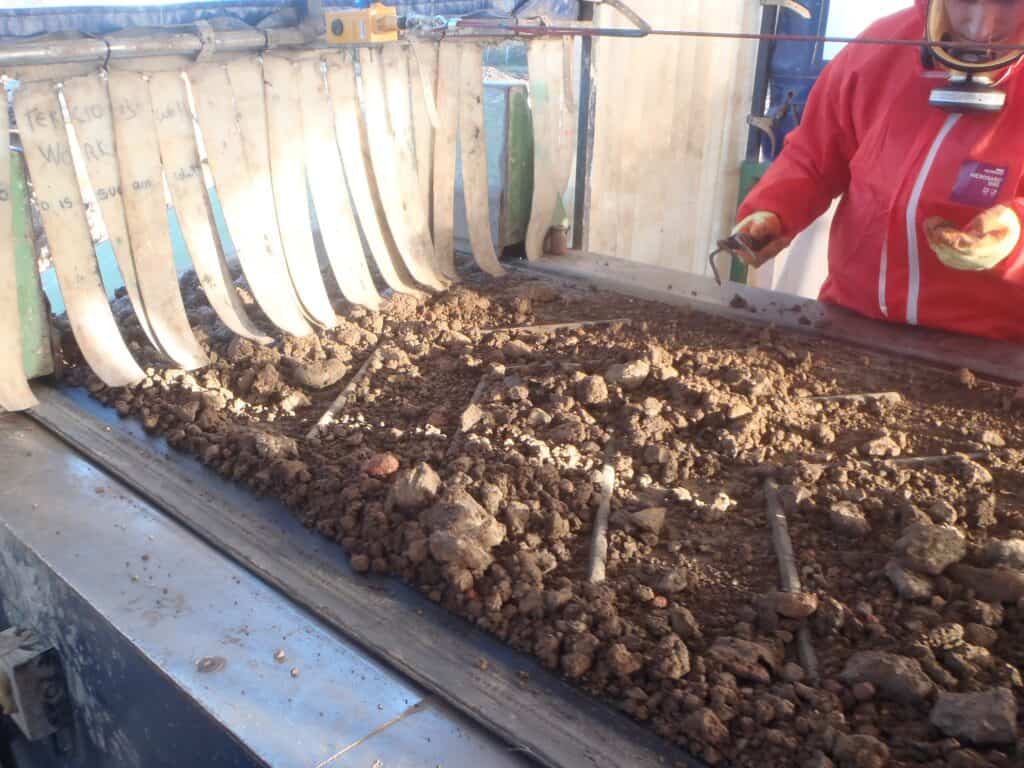
  • Selective excavation, sorting and in-situ manual picking of ACM fragments;
  • Screening and manual picking of ACM fragments, in an enclosed picking station for higher quantities of material;
  • Stabilisation and / or encapsulation of ACS to minimise the likelihood for residual fibre release;
  • Stringent environmental monitoring and controls, including fine-mist (virtual enclosure) suppression systems, reassurance air testing and scanning electron microscopy analysis to confirm airborne fibre concentrations are below HSE control limits as well as environmental background levels.

All Soilfix staff working with asbestos are Non-licensed/Notifiable non-licensed work trained and have regular medicals and respirator face-fitting to ensure compliance with CAR2012.

For more information about asbestos removal in soil and demolition materials in Cambridge and the surrounding areas, get in touch with a member of our expert team today.

soil and groundwater remediation
bioremediation Soilfix

Bioremediation

Our specialist bioremediation service in Cambridge and the surrounding areas is carried out by our expert team. Lots of organic contaminants provide an energy source for naturally occurring micro-organisms present within the soil (e.g. bacteria). Under the right environment, these organisms will degrade organic contaminants to form less toxic and/or more stable materials.

These processes can be excelled by manipulating the conditions within the soils that enable the relevant micro-organisms to both interact and thrive with the contaminants. The presence of nutrients and available carbon within the soil will provide the groundwork for the organisms and can be artificially increased with the application of various bio-nutrient products or fertilisers. Optimising pH, temperature, moisture and oxygen conditions can expand populations and enable maximum interaction with the contaminant.

Ex-situ soils can use vented biopiles or windrow technologies to speed up bioremediation. Bio-venting, sparging or permeable reactive barriers (PRBs) can be used to accelerate the process in-situ.

The solutions that will allow you to achieve the highest rates of bioremediation at your site can be designed and built by Soilfix. Where more complex contaminant situations, gross start concentrations or biomass limited situations occur, Soilfix has experience in bio-augmentation using both specially cultured and indigenous biomass to boost the treatment process.

Stabilisation - Solidification Soilfix
Stabilisation Soilfix

Soil Stabilisation / Solidification Cambridge

A increasingly affordable technology for the quick treatment and/or immobilisation of hazardous wastes and polluted soils or sludge is soil stabilisation or solidification. The terms “solidification” and “stabilization” describe two specific mechanisms.

  • Solidification changes the physical properties of contaminated material to increase its compressive strength, decrease its permeability, and encapsulate hazardous constituents.
  • Stabilisation changes the chemistry of certain hazardous constituents, making them less mobile, less soluble, and/or less toxic.

Prior to beginning the work,  samples of the corrupt material are taken and laboratory pilot trials conducted to determine the most cost effective reagent or combination of reagents to achieve the site remedial targets. Binding agents are then applied and the soils rotivated either in-situ (e.g. auger, injection, rotivator) or ex-situ (e.g. batching plant, blending equipment). Performance testing of the treated materials is usually completed throughout the works. According to the specifications, testing on hydraulic conductivity, unconfined compressive strength, and leachate characteristics may be included.

Speak to us today for more information about soil stabilisation / solidification in Cambridge.

Insitu Remediation Soilfix

In-Situ / Ex-Situ Groundwater Treatment Cambridge

Soilfix has extensive experience in adopting a wide variety of both conventional and more innovative in-situ / ex-situ groundwater treatment technologies in Cambridge to meet site specific remedial objectives and / or enable excavation and removal of in-ground obstructions.

  • Using air stripping, filtration, and solids/NAPL separation for total fluid recovery and ex-situ treatment;
  • Surfactant-enhanced total fluids recovery through injection or groundwater recirculation;
  • Free-product recovery (with and without vacuum-enhancement) using dual-phase, pneumatic skimming and multi-phase vacuum extraction techniques;
  • Air sparge / SVE systems (including use of ozone);
  • Enhanced natural attenuation techniques for both aerobic and reductive treatment to stimulate accelerated biodegradation (for solvents, trace organic compounds and hydrocarbons) or precipitation (e.g. hexavalent chromium); and,
  • Reduction technologies / in-situ chemical oxidation.

Soilfix also has experience in carrying out thermally-enhanced treatment using both steam and electric conductive heating using specialist partners.

Get in touch today to find out more about our Cambridge soil and groundwater treatment services.

Enquiries for soil and groundwater remediation in Cambridge

Peter Howland
Managing Director