Stabilisation / Solidification
Soilfix provides a wide variety of stabilisation / solidification (S/S) treatment techniques for both remediation of leachable contaminants and geotechnical improvement (e.g. for engineered development platforms). By continually advancing this technology both ex-situ and in-situ, more complex contaminants can be immobilised, including PFAS compounds, coal-tar residues, crude oils, soluble metals and persistent organic compounds (POP’s).
Stabilisation / Solidification of soils is increasingly a cost-effective technology for the rapid treatment and / or immobilisation of hazardous wastes and contaminated soils or sludge’s. The terms “solidification” and “stabilisation” describe two distinct mechanisms.
- Solidification changes the physical properties of contaminated material to increase its compressive strength, decrease its permeability, and encapsulate hazardous constituents.
- Stabilisation changes the chemistry of certain hazardous constituents, making them less soluble, less mobile, and/or less toxic.
Our solution
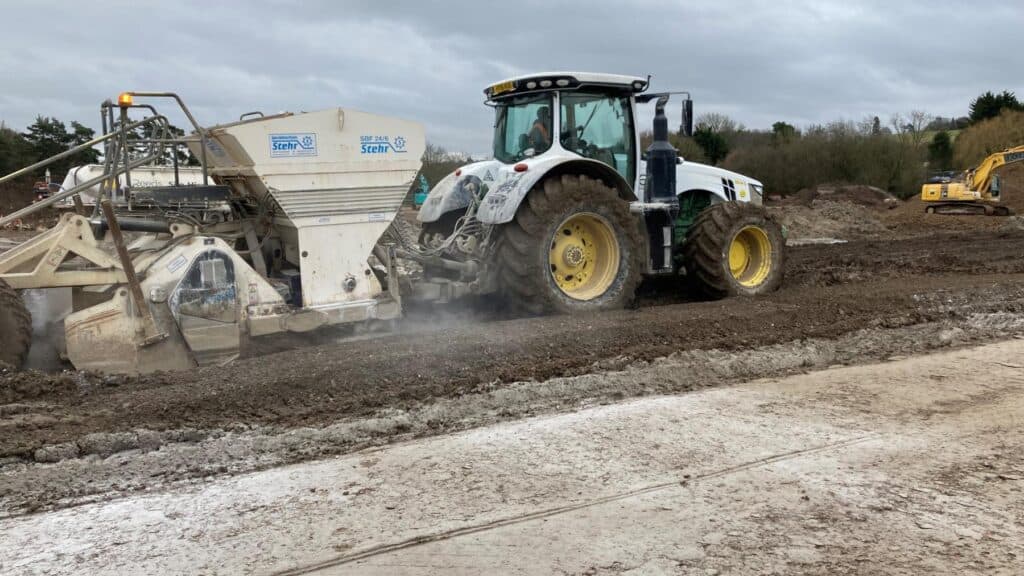
Prior to commencing, samples of the contaminated material are taken and laboratory-scale trials conducted to calculate the most cost-effective reagent or combination of reagents to achieve site-specific objectives. Binding agents are then applied and the soils rotavated either in-situ (e.g. auger, injection, rotavator) or ex-situ (e.g. batching plant, blending equipment). Traditional binding agents including Ordinary Portland cement (OPC) and quicklime can be combined with admixtures for enhanced sorption, including fly-ash, blast-furnace slag, powdered activated carbon and biochar.
Soilfix has effectively combined S/S treatment with chemical oxidation on NAPL-saturated soils, reducing the more mobile contaminant loading, whilst immobilising residual contamination.
Performance testing of the treated materials is usually completed throughout the works. Depending on requirements this can include tests on hydraulic conductivity, unconfined compressive strength, CBR and leachate characteristics.
Stabilisation/solidification can be tailored to meet both the remediation and construction objectives of a project (e.g. using contaminated soils to form a piling mat, capping layer or engineered sub-capping fill). Achieving a target (post-treatment permeability) can form an integral part of a remediation strategy through construction of an in-ground barrier or capping systems to manage groundwater flows and infiltration respectively.