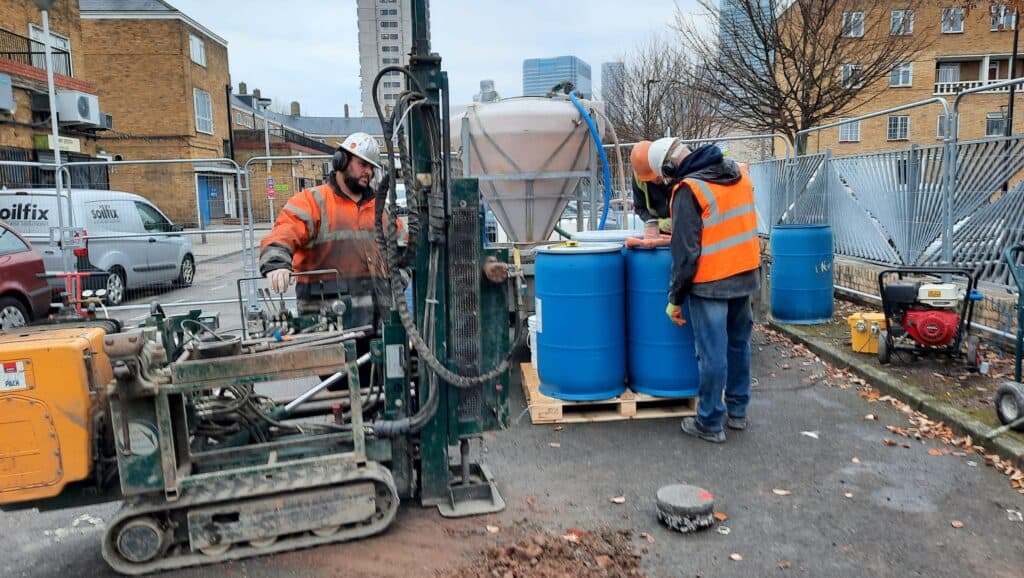
Soilfix Director Steve Jackson recently wrote an article to discuss the issue of Per/Poly-fluoralkyl substances (PFAS), commonly termed ‘forever chemicals’, and how secondary contamination sources should be more proactively managed to unlock the current ‘stall’ of many problem sites. This article can be found here and is reproduced below…..
The current PFAS Plan……
The recent publication of DEFRA’s PFAS Plan: Building a Safer Future Together was a welcome step, swiftly followed by the House of Commons Environmental Audit Committee (EAC) report Addressing the Risks from Perfluoroalkyl and Polyfluoroalkyl Substances (PFAS). Yet, despite this momentum, both documents highlight a familiar problem: the UK is still talking far more than it is acting.
The EAC’s conclusion is hard to dispute: while the Government’s first PFAS plan is welcome, it remains “short on decisive actions to prevent the harmful build‑up of these chemicals in the environment… [and] disproportionately focuses on expanding PFAS monitoring rather than preventing or remediating contamination.”
This lack of decisive action is reflected in the PFAS Plan itself. As Richard Ogden of SLR Consulting astutely noted at last week’s 21st annual South‑East Soils (SSE21) Seminar I attended at Greenwich University, many of the 49 actions listed across the Plan’s three themes – understanding sources, tackling pathways, and reducing exposure – are not actions at all. They rely heavily on non‑committal language such as consider, explore, review, evaluate and consult. Of these 49 actions, only 𝘢𝘳𝘰𝘶𝘯𝘥 20 𝘢𝘳𝘦 𝘳𝘦𝘭𝘦𝘷𝘢𝘯𝘵 𝘵𝘰 𝘭𝘢𝘯𝘥 𝘲𝘶𝘢𝘭𝘪𝘵𝘺 𝘱𝘳𝘢𝘤𝘵𝘪𝘵𝘪𝘰𝘯𝘦𝘳𝘴, and just 𝘰𝘯𝘦 𝘴𝘪𝘯𝘨𝘭𝘦 𝘢𝘤𝘵𝘪𝘰𝘯 has any real potential to influence remediation or disposal decisions!
Some MPs have responded to the EAC report by calling for a complete ban on PFAS in consumer products unless manufacturers can prove essential use. While tackling PFAS at source is vital, a blanket ban is far from straightforward. Without a broad, ‘group‑based’ restriction, the UK risks a regulatory “whack‑a‑mole” approach – restricting one PFAS only for another to emerge in its place. Government must draw on independent scientific and regulatory expertise to implement group‑based restrictions that can adapt swiftly as new evidence emerges.
The Challenge of Secondary Sources……
Beyond restrictions, addressing secondary source sites must be a priority. As Nancy Tonkin of Tetra Tech highlighted at last week’s SSE21, removing all PFAS from the environment is simply not possible. The UK may need to adopt an ‘as far as reasonably practicable’ approach – balancing technical feasibility, environmental sustainability, available budgets and proportionality between risks and costs.
Nancy also warned that the UK is becoming overly fixated on future environmental quality standards (that have not yet materialised). As a result, many PFAS source‑management projects are, unfortunately, stalling. In reality, both problem‑holders and regulators would be better served by taking action now, accepting that some refinement may be needed later, rather than waiting indefinitely for perfect standards that may never arrive.
A Growing Legacy Burden…….
PFAS contamination already represents a significant legacy burden for the UK. Even with strong restrictions on future use, thousands of sites are affected. The Environment Agency estimates remediation costs of £31–121 billion across 2,900 to 10,200 high‑risk locations. Without clearer direction, this legacy will continue to pose long‑term risks to public health and the environment, while escalating costs fall to government, taxpayers, water companies and ultimately bill payers.
At present, PFAS “problem‑holders” – including landowners, developers and industry- lack the certainty needed to invest in remediation. Many are understandably reluctant to act without assurance that they will not later be required to meet new, more stringent or technically unachievable standards. The diffuse and historic nature of PFAS use further complicates liability, often leaving no clear polluter to pursue and shifting the financial burden to the public.
Unlocking Action Through Clear, Credible Guidance
To encourage proactive remediation and reduce long‑term costs to taxpayers and water bill payers, the UK Government must provide clear, authoritative guidance and a credible commitment that those who act now will not face retrospective liability. This clarity is essential to unlock investment, address secondary sources of contamination, and ensure PFAS risks are managed effectively and fairly.
This Guidance should:
- Set out interim Environmental Quality Standards for key ‘priority’ PFAS compounds, drawing on international best practice and current scientific evidence, with a focus on the most prevalent and persistent substances in the UK, including PFOS and PFOA.
- Promote a risk‑based approach consistent with existing UK contaminated land practice, enabling proportionate decision‑making and confidence in achieving a ‘no further action’ outcome where appropriate.
- Apply Best Available Techniques principles to ensure remediation methods are selected through a robust options appraisal that considers economic, environmental and social factors, with sustainability as a central driver.
- Provide clear direction on viable remediation technologies, supported by evidence‑based evaluation, to enable effective, safe and scalable treatment of contaminated materials, including soil and water.
This guidance should be underpinned by some form of Regulatory Position Statement from the Environment Agency, developed in collaboration with Scottish Environment Protection Agency and Northern Ireland Environment Agency, to reassure responsible parties that they will not be required to undertake additional PFAS remediation in future beyond the standards and approaches set out therein.
By doing so, businesses, local authorities and regulators would gain the clarity needed to deliver timely, safe and effective PFAS remediation. The first iteration of such guidance may not be perfect, but it would be far preferable to continued delay.
So finally I return to the EAC Report, which rightly observed “The longer action is delayed in addressing the risks of PFAS, the greater the health, economic and environmental burdens will become.” Yet these “forever chemicals” continue to leach into our environment, while the UK deliberates how best to respond. Without decisive action, the scale and cost of PFAS contamination will only continue to grow…….